
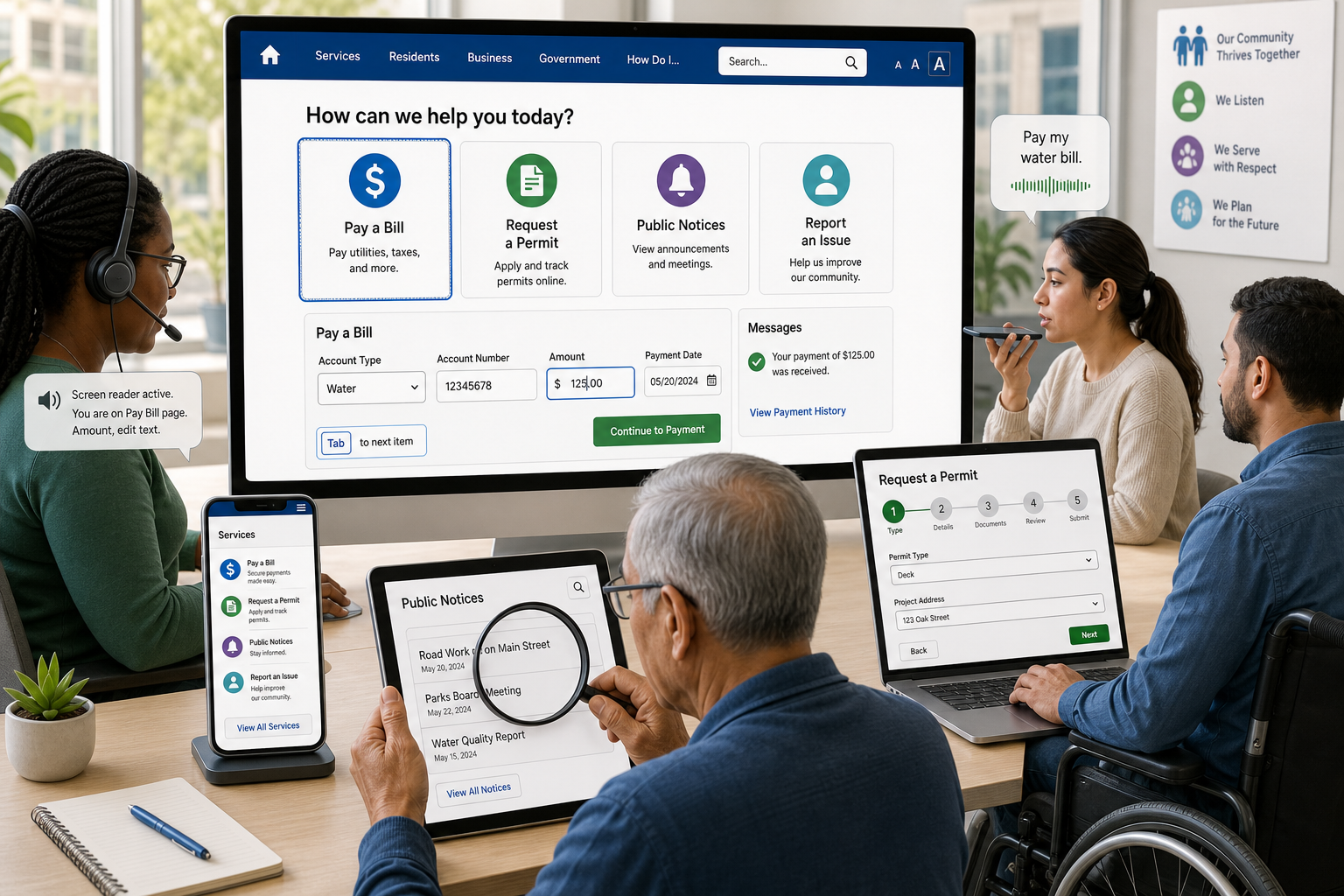
Local government websites need accessible design to meet ADA-related public access obligations and help residents find information, complete forms, and use services without barriers. The focus is on practical online access for people using assistive technologies, mobile devices, or older browsers.
Accessibility features such as clear structure, readable text, keyboard navigation, captions, and proper form labeling improve usability for everyone. These improvements can reduce errors, support timely communication, and make digital government services more consistent and dependable.
The significance of web accessibility on local government websites, including those for states, counties, cities, and towns, as required by the Justice Department, is to enhance digital accessibility for residents in line with ADA laws and related public access obligations. This means ensuring that people with disabilities can use public-facing websites to find information, complete forms, access services, and communicate with government offices without unnecessary barriers. It also means making sure that essential public information is available in a way that does not depend on a single method of interaction, since residents may rely on screen readers, voice input, captions, magnification, or keyboard-only navigation to access content effectively. In a local government setting, this is especially important because many core services, from bill payment to public notices, are now delivered primarily online, and barriers on a website can quickly become barriers to civic participation, service access, and timely communication. When websites are inaccessible, residents may miss deadlines, struggle to request help, or be unable to complete basic tasks that are now expected to be available digitally. In that sense, accessibility is not just a technical issue, but a practical public service issue that affects day-to-day interactions between government and the people it serves. It also reflects a commitment to equal treatment, since public agencies are responsible for serving the entire community, not only those who can easily use standard web interfaces. Accessible design can include readable text, keyboard navigation, clear headings, descriptive links, and compatibility with assistive technologies, all of which make websites easier to use for a wider range of people. Other helpful practices may include sufficient color contrast, alt text for images, properly labeled form fields, captions for video content, and layouts that remain understandable when zoomed or viewed on different devices. These features do not just support users with disabilities; they also improve the overall structure and clarity of a website, making it simpler for everyone to locate information and complete tasks efficiently. When content is organized logically and written clearly, visitors can move through pages more confidently, whether they are using a desktop computer, a tablet, or a phone, and whether they are visiting during business hours or outside them. In many cases, accessibility improvements also reduce frustration for users who are unfamiliar with government processes or who need to find information quickly without searching through confusing pages. Well-designed accessible pages can also lower the chance of errors in forms and reduce the need for residents to call or visit offices for basic assistance. Over time, these improvements can save staff time as well, because fewer users encounter dead ends, broken workflows, or confusing instructions that require manual follow-up. They can also make it easier for agencies to maintain content consistently, since accessible structure and clear labeling often lead to better organization across the site. By improving accessibility, local governments make it easier for all residents to participate in civic life, whether they are paying taxes, requesting permits, reviewing meeting agendas, or accessing emergency updates. Accessible websites also help residents stay informed about public hearings, local services, election details, and community resources, especially when timely access matters most or when in-person assistance is limited. It also helps residents who may be using mobile devices, slower internet connections, or older browsers, since many accessibility best practices improve overall usability and performance. In practice, this supports compliance efforts and helps public agencies provide a more inclusive and usable online experience for the communities they serve, while reducing confusion, lowering barriers to service, and strengthening trust in local government. Over time, these improvements can contribute to more effective communication between agencies and the public, making digital government services more dependable, more equitable, and easier for everyone to use. They also support a more consistent standard of service across departments, so that residents encounter fewer obstacles no matter which office, page, or online form they need to use. For local governments, that consistency matters because residents often interact with multiple agencies, and a clear, accessible experience across all of them helps create a smoother and more reliable public service environment. It can also encourage greater public engagement, since residents are more likely to use online services and stay informed when they know the information will be available in a usable format.
